MoE Inference Is Becoming a Rack-Scale Systems Problem, Not Architecture Trivia

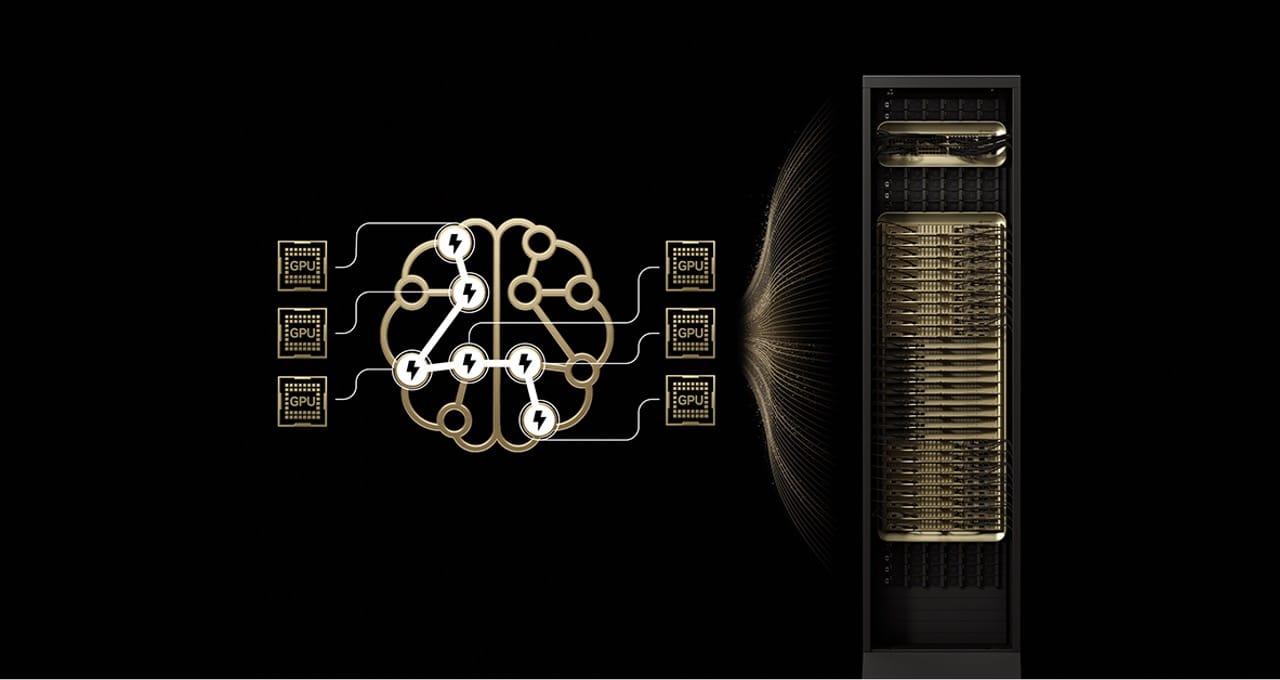
Mixture-of-experts models used to be a model-architecture detail. Now they are an infrastructure procurement strategy.
NVIDIA’s latest Blackwell NVL72 pitch is nominally about MoE models running “10x faster” at “one-tenth the token cost.” Fine. Vendor math belongs in the same drawer as benchmark charts until proven otherwise. But the more interesting part is why the claim is plausible at all: frontier inference has stopped being a single-GPU acceleration problem and become a rack-scale distributed-systems problem that happens to emit tokens.
That shift matters for anyone building products on top of open frontier models. NVIDIA says the top 10 most intelligent open-source models on Artificial Analysis now use mixture-of-experts architectures, including DeepSeek-R1, Kimi K2 Thinking, OpenAI’s gpt-oss-120B, and Mistral Large 3. It also says more than 60% of open-source AI model releases this year use MoE, and that MoE has helped drive a nearly 70x increase in model intelligence since early 2023. Even if you discount the marketing gloss, the direction is hard to ignore: sparse activation is becoming the default path to bigger models that do not melt the budget on every token.
The catch is that MoE only looks simple from the model card.
The router moved the bottleneck
Dense models are expensive in an obvious way: every token touches the whole model. MoE models are expensive in a less obvious way: each token touches only a subset of experts, but those experts may be scattered across GPUs, loaded under tight latency constraints, and coordinated through all-to-all communication patterns that punish sloppy topology.
NVIDIA’s technical deep dive gives the concrete shape of the problem. DeepSeek-R1 has 256 experts and 671 billion parameters, with eight active experts per token. Expert parallelism distributes those experts across GPUs so each device carries fewer expert weights and sees less memory pressure. That helps. But every transformer block still needs to dispatch tokens to the selected experts, run grouped matrix multiplications, gather results, and keep the next token moving fast enough that users do not feel the distributed system hiding under the chat box.
This is why NVIDIA is talking about GB200 NVL72 as a rack-scale system rather than just “faster Blackwell GPUs.” The system combines 72 Blackwell GPUs, 1.4 exaflops of AI performance, 30TB of fast shared memory, and 130 TB/s of NVLink connectivity through NVLink Switch. The point is not only more compute. It is keeping expert routing inside a high-bandwidth domain so the MoE efficiency gain is not eaten by communication overhead.
In other words: MoE made the model sparse, then handed the infrastructure team a scheduling problem.
Token economics now depend on topology
NVIDIA says Kimi K2 Thinking, DeepSeek-R1, and Mistral Large 3 see a 10x performance leap on GB200 NVL72 versus HGX H200, enabling roughly one-tenth the cost per token. Its related SemiAnalysis InferenceMAX writeup says Blackwell shows a 15x gain over Hopper for DeepSeek-R1 8K/1K, while Llama 3.3 70B reaches 10,000 tokens/sec at 50 TPS/user, more than 4x H200 per-GPU throughput. For gpt-oss-120B, NVIDIA says TensorRT-LLM optimization work produced 60,000 TPS/GPU max throughput, 1,000 TPS/user max interactivity, and a 5x performance improvement in two months.
The numbers are useful, but the lesson is not “buy the biggest rack and declare victory.” The lesson is that cost per token is now a function of model shape, precision format, prefill/decode split, expert parallelism degree, interconnect topology, batch profile, context length, concurrency target, and latency SLO. If your benchmark report does not say input/output sequence length, time-to-first-token, inter-token latency, concurrency, and price assumptions, it is not a benchmark. It is a mood board.
This is where InferenceMAX is directionally healthier than most one-number comparisons. It tests chat, summarization, and deep-reasoning profiles across DeepSeek-R1, gpt-oss-120B, and Llama 3.3 70B, with variable sequence lengths and continuous benchmark sweeps across SGLang, TensorRT-LLM, and vLLM. That framing forces practitioners to ask the right question: not “how fast is the model?” but “under what user experience target, with what sequence shape, on what serving stack?”
NVFP4 deserves the same treatment. NVIDIA points to DeepInfra reducing cost per million tokens from $0.20 on Hopper to $0.10 on Blackwell, then to $0.05 with Blackwell NVFP4 and TensorRT-LLM. That is a real economic lever if accuracy holds for your workload. But lower precision is not a free lunch; teams should test task quality, refusal behavior, tool-call accuracy, and long-context stability before swapping formats in production. The token invoice is not the only metric that can regress.
What engineers should actually do
If you are serving ordinary application traffic on hosted APIs, this might sound remote. It is not. MoE economics upstream eventually become API pricing, rate limits, latency guarantees, and which models are cheap enough to use inside agent loops. When the serving stack gets more efficient, product builders get permission to use stronger models more often. When it does not, “agentic workflow” quietly becomes “one expensive reasoning call wrapped in optimism.”
For infrastructure teams running models directly, the action items are more concrete. First, separate prefill and decode in your mental model and your metrics. Long prompts, retrieval stuffing, tool schemas, and conversation history punish prefill differently than short interactive decode. Second, benchmark MoE models at the latency target your product actually needs. “Maximum throughput” is trivia if your users abandon the workflow after a slow first token. Third, treat expert parallelism as a tuning surface, not a checkbox. The Wide-EP post says large EP rank 32 delivers up to 1.8x higher output-token throughput per GPU than small EP rank 8 at 100 tokens/sec/user, but that gain depends on the model, interconnect, concurrency, and workload shape.
Fourth, make observability boring before scaling. Track hot experts, GPU imbalance, cache pressure, network collectives, queue depth, TTFT, ITL, and cost per completed task rather than cost per generated token alone. A cheap token that causes an agent to take five extra tool turns is not cheap. Fifth, do not assume GB200 NVL72 conclusions transfer cleanly to a PCIe box, mixed cloud fleet, or smaller on-prem cluster. The 130 TB/s NVLink domain is the product. If your topology cannot keep expert communication local and fast, your Pareto frontier will move.
The broader product implication is that the next competitive layer in AI infrastructure is not only model quality. It is routing quality: routing tokens to experts, routing prefill and decode across GPU pools, routing local versus cloud execution, routing cheap versus frontier models, and routing agent subtasks to the right specialized component. NVIDIA even makes the analogy explicit, describing agentic systems as planners, perception modules, reasoning engines, tools, and search components coordinated by an orchestrator. That is MoE as an application architecture pattern, not just a transformer trick.
That framing is useful, but it should make engineers cautious. Shared expert pools create shared failure modes: noisy neighbors, unpredictable latency, harder billing, isolation questions, and debugging sessions where the model was fine but the router made a bad systems decision. The winners here will not be the teams with the flashiest “10x” slide. They will be the teams that can give application developers a reliable envelope: this model, this latency, this context size, this cost, this degradation behavior when traffic spikes.
NVIDIA’s argument is self-serving, obviously. The company sells the racks, the interconnect, the kernels, the inference frameworks, and the story that all of those should be bought together. But the underlying point is correct: MoE has turned frontier inference into a full-stack systems problem. If you are still evaluating model deployments by asking whether the weights fit on a GPU, you are reviewing the wrong diff.
Sources: NVIDIA Blog, NVIDIA Developer Blog, NVIDIA Developer Blog on SemiAnalysis InferenceMAX, Artificial Analysis