NVIDIA AI-Q Turns Deep Research Into an Agent Skill — Which Is the Right Kind of Laziness

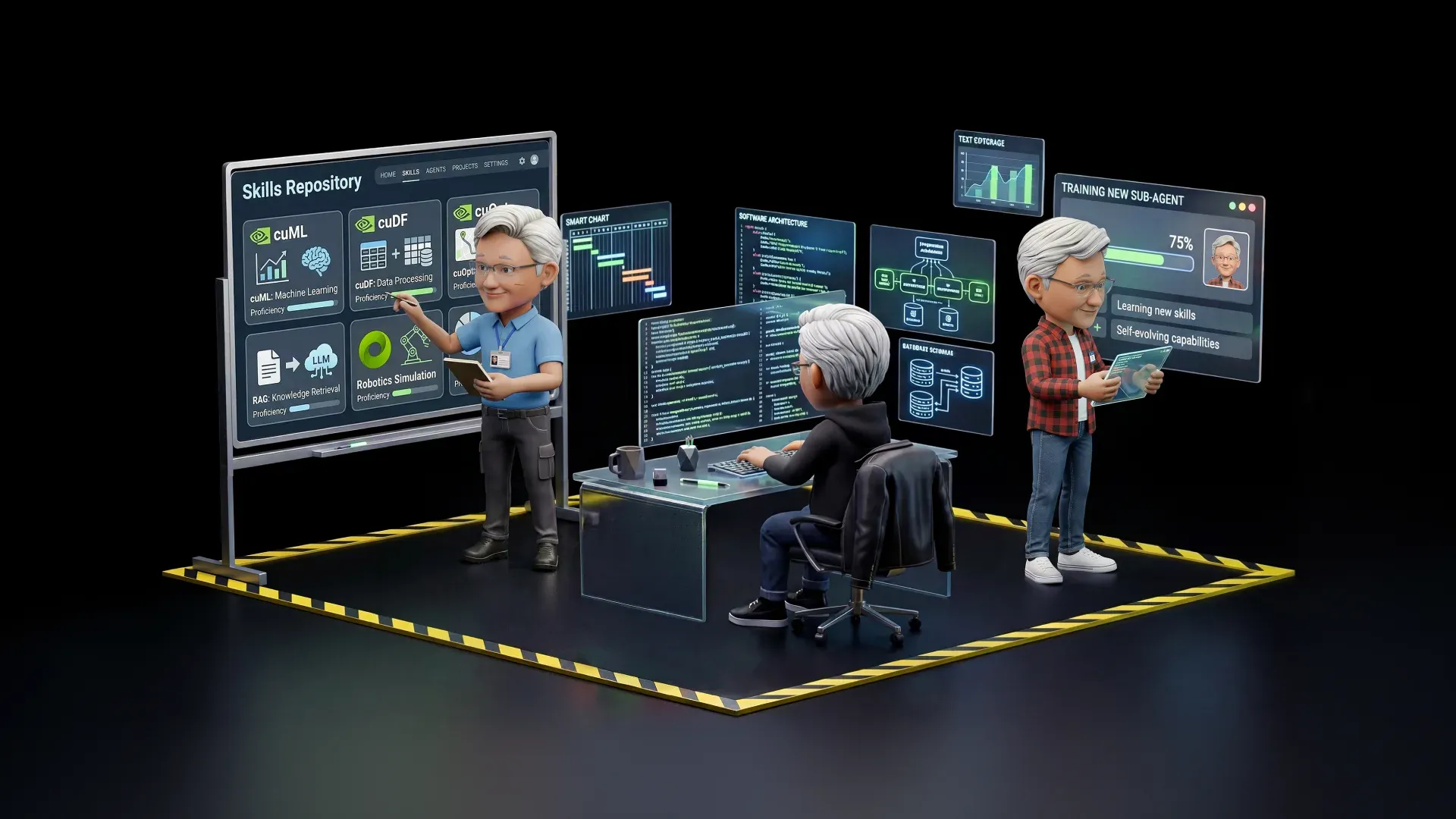
NVIDIA’s AI-Q deep-research skill is easy to undersell if you read it as another “now your coding agent can research things” announcement. That is the boring interpretation, and probably the wrong one.
The more interesting move is architectural: NVIDIA is turning deep research into a delegated backend capability. Claude Code, Codex, OpenCode, or another harness owns the conversation and task orchestration. AI-Q owns the messy research pipeline: routing, retrieval, planning, async jobs, citations, identity propagation, and enterprise data access. That separation is the whole story. Serious research is not “search in a loop.” It is a workflow with trust boundaries.
The new post, Add a Specialized Deep Research Skill to Agent Harnesses, describes a portable skill that lets an agent harness submit research jobs to a running AI-Q server. The skill includes a SKILL.md plus a helper script, scripts/aiq.py, that handles request routing, job submission, polling, and result retrieval. By default, it targets http://localhost:8000, with AIQ_SERVER_URL available for override.
Installation paths cover the usual agent workbench suspects: Claude Code skills directories, Codex-configured skill directories, and OpenCode under ~/.config/opencode/skills/. That portability matters, but it is not the real product. The product is the boundary between a general-purpose agent and a governed research system.
The agent should ask for research, not inherit the whole data estate
Enterprise research workflows are where demo agents go to become security incidents. A useful research assistant may need internal policy documents, legal repositories, financial data, clinical notes, engineering docs, support tickets, customer records, or regulated filings. A coding agent sitting in a repo should not automatically receive broad direct access to all of that. It may only need the final cited memo, generated inside an environment that already understands access control and audit requirements.
AI-Q’s skill model is clean because it delegates the bounded capability. The harness can say, effectively: “Research this topic and return a structured, cited report.” AI-Q can decide whether the task needs clarification, shallow research, deep research, authenticated data sources, or longer-running async execution. NVIDIA describes stages including intent classification, human-in-the-loop clarification, shallow research, and deep research, evaluated with FreshQA, Deep Research Bench, and DeepSearchQA.
That is a much better division of labor than forcing every agent harness to grow its own RAG backend, citation tracker, auth system, long-job queue, and evaluation harness. Teams already have too many half-built internal search tools. The last thing they need is five more, each wrapped in a different agent prompt.
MCP auth is the buried lede
The most important section is not the install command. It is authentication.
NVIDIA documents AI-Q support for authenticated MCP servers as data sources through NeMo Agent Toolkit function groups. The post lays out three patterns: unauthenticated MCP via mcp_client, service-account authentication with mcp_client plus mcp_service_account, and forwarding the signed-in AI-Q user’s bearer token through a custom tool using get_auth_token(). For protected MCP servers, NVIDIA recommends streamable-http over SSE and says it is required for production auth.
That is where the demo becomes architecture. Service accounts are convenient for shared data sources and batch jobs, but they flatten identity if used carelessly. User-token forwarding preserves per-user access controls, but it creates token-lifetime, audit, and delegation questions. NVIDIA notes a real limitation: the per-user bearer token is captured at job submission time and restored inside async Dask workers, but tokens are not refreshed mid-job yet. Long jobs can fail when access tokens expire; in-worker refresh is planned later.
This is exactly the kind of unsexy operational detail that decides whether a system works. A deep-research job that fails after 45 minutes because an access token expired is not a corner case. It is enterprise software behaving normally. Builders should prefer vendors and frameworks that say these parts out loud.
Skills should become facades over governed systems
The broader lesson is that agent skills do not all need to be tiny prompt recipes. Some should be facades over substantial systems: research backends, incident-response workflows, compliance checkers, code-review services, model-evaluation harnesses, migration planners. The agent calls the capability. The capability enforces its own data, policy, logging, and audit constraints.
That is the right kind of laziness. Do not teach every agent to browse every internal source. Teach the agent how to ask the governed research service for the artifact it needs. Do not give a coding harness raw access to policy stores if a cited answer is sufficient. Do not let a local agent improvise compliance analysis if a controlled backend can retrieve approved sources, preserve citations, and log the access path.
For practitioners, the checklist starts before installation. Where does AI-Q run — laptop, cloud, on-prem Kubernetes, air-gapped data center? Which MCP servers can it reach? Does it use service credentials or per-user delegation? Are documents allowed to leave the environment? Who can submit jobs? Are async traces exported through OpenTelemetry or another observability path? Are citations enough for audit, or do you need retrieved-document IDs, access-control decisions, and source snapshots? How are prompts, workflow YAML, and data-source plugins versioned?
NVIDIA’s AI-Q repository positions the blueprint as an enterprise-grade research agent built on NeMo Agent Toolkit and LangChain Deep Agents, with shallow and deep research, YAML workflow configuration, evaluation harnesses, CLI/web UI/async jobs, Docker Compose, and Helm deployment assets. The repo snapshot from the research run showed 568 stars, 171 forks, and 15 open issues. That is early, but enough signal to say builders are at least inspecting the pattern.
The comparison point is not only “Claude Code can research now.” It is the last generation of enterprise RAG chatbots, many of which answered questions without durable workflow control, weak citations, unclear identity propagation, and thin evals. AI-Q’s advantage is packaging retrieval, planning, citations, data-source plugins, async jobs, and evaluation into a single blueprint. Its disadvantage is the usual blueprint problem: production fit depends on the seams — auth, deployment, model availability, observability, schema stability, cost, and how painful it is to add the one internal source the demo did not anticipate.
Still, this is the direction agent systems should move. General-purpose harnesses are good at coordination. Specialized backends are better at controlled execution inside sensitive domains. If agents are going to be useful in regulated industries — healthcare, financial services, government, defense, manufacturing, public sector — capability delegation beats capability sprawl.
The editorial read is simple: AI-Q matters less as a research demo than as a trust-boundary pattern. Let the agent ask. Let the governed system do the sensitive work. Return the cited artifact. Log the path. That is how agent skills become infrastructure instead of another folder of clever prompts.
Sources: NVIDIA Developer Blog, NVIDIA AI-Q Blueprint, AI-Q docs, NVIDIA NeMo Agent Toolkit docs, AI-Q research skill directory