NVIDIA’s ICRA Research Says Physical AI Is Becoming a Sim-to-Real Toolchain

Robotics has spent years producing videos that look ten years ahead of the actual deployment curve. NVIDIA’s ICRA 2026 research package is useful because it mostly avoids that trap. The interesting part is not that a robot arm grasped something or a humanoid walked somewhere. The interesting part is that NVIDIA is turning physical AI into a software toolchain: simulation, GPU planning, synthetic trajectories, open datasets, Isaac Lab, Omniverse, robot policies, agent skills, and runtime correction loops.
That is the right level of ambition. Real robots do not fail because one component is obviously bad. They fail at the seams: the planner assumes a clean shelf, the camera sees irrelevant clutter, the grasp model does not handle a weird object, the simulator misses a tolerance issue, or a language-conditioned policy says the right thing and moves the wrong part. NVIDIA’s highlighted ICRA work targets those seams directly.
The company says it had 28 accepted ICRA papers and highlighted eight focused on sim-to-real transfer: multi-arm planning, cross-embodiment navigation, grasping, deformable manipulation, precision assembly, sequential assembly, visual focus for policies, and runtime alignment between plans and actions. Read together, they are less a demo reel than a map of robotics failure surfaces.
The stack is starting to look like infrastructure
ScheduleStream is the cleanest systems story. It runs computations on GPUs so multiple robot arms can plan movements and operate in parallel, with NVIDIA reporting a 3x speedup across multi-arm planning scenarios on hardware including Jetson. The open GitHub project supports task-and-motion planning with cuRobo, Isaac Lab demonstration generation, cuMotion, Trimesh 2D, and Blocksworld. Multi-arm planning sounds niche until you remember that factories, warehouses, and labs do not buy robots so they can politely wait for each other.
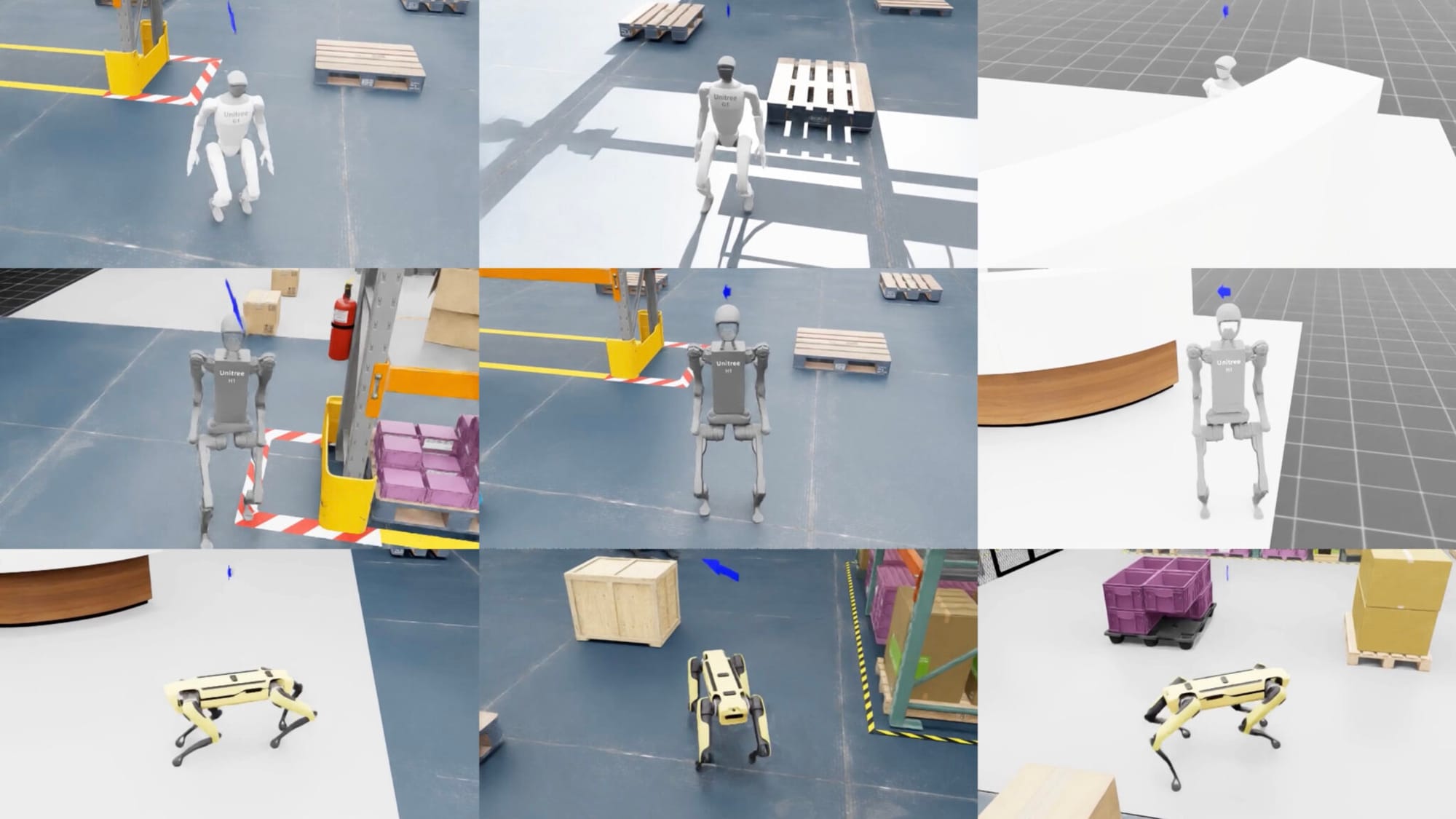
COMPASS attacks a different problem: how to train mobility policies that transfer across robot bodies. It combines imitation learning, residual reinforcement learning in Isaac Lab, and policy distillation to build cross-embodiment policies without real-world robot data during training. NVIDIA reports a 4.5x improvement in average success rate versus an imitation-learning baseline and about 80% success across 20 real-world navigation trials on autonomous mobile robots and humanoids. That is not a production guarantee, but it is a useful signal: the robotics stack is moving from “train one policy for one body” toward reusable training recipes that understand embodiment as a variable.
Then there is Grasp-MPC, which is the sort of work that looks boring only if you have never watched a robot fumble a simple pick. It generated 2 million simulated trajectories across 8,000 objects using GraspGen annotations and cuRobo motion-planning data, then achieved roughly 75% real-robot grasping success on novel objects in clutter versus 41% for a baseline. The broader GraspGen repo describes a diffusion-based 6-DOF grasping framework with three gripper types, a 17% FetchBench improvement, 21x less memory, 20 Hz before TensorRT, MCP/LLM tool-calling support, and a dataset of more than 57 million grasps computed for 8,515 Objaverse XL objects.
Those details matter because grasping is where robotics stops being abstract. A robot does not need a poetic world model to fail; it just needs a handle, bag, cable, branch, or oddly reflective object that violates the training distribution. Simulated trajectories and large grasp datasets are useful only if the system can keep correcting as reality disagrees with the plan. Grasp-MPC’s continuous correction framing is exactly the kind of mundane resilience robotics needs.
Simulation is not a religion. It is a source of controlled mistakes.
The healthy pattern across the highlighted papers is that NVIDIA is not treating simulation as magic. COMPASS uses residual RL and distillation to adapt across bodies. SPARR trains a general assembly strategy in Isaac Lab, then learns real-hardware corrections through the robot’s camera without human demonstrations. NVIDIA reports a 38% success-rate improvement, roughly 30% cycle-time reduction, and nearly 75% success improvement on unseen NIST assembly tasks versus zero-shot sim-to-real baselines. Refinery trains across hundreds of simulated assembly scenarios and reports 91% simulation success plus nearly 11% mean improvement over baselines, with comparable real-world results.
The distinction matters. “Train in sim, deploy in reality” is too clean a story. The useful version is “train many structured mistakes in sim, then build mechanisms for reality to correct you.” Hardware tolerances, lighting, object wear, occlusion, cable flex, and human rearrangement are not edge cases in robotics. They are the job.
Deformable Cluster Manipulation makes that point in a more physical way. NVIDIA describes a tree generator based on biological growth equations used to train across thousands of synthetic trees, then deploy zero-shot to real branches for tasks like clearing tangled material from power lines. This is the opposite of benchmark theater: branches deform, tangle, occlude, and behave differently under contact. If the simulator only teaches rigid-body optimism, reality wins. If it teaches enough variation and the policy can tolerate error, simulation becomes a practical data engine.
Perception and plans need runtime guardrails
PEEK and SEAL are the most relevant pieces for teams thinking about language-conditioned robots or VLA models. PEEK uses a vision-language model to focus the robot’s image input around task-relevant objects. NVIDIA reports a 41x real-world accuracy improvement for a simulation-trained policy and 2–3.5x gains for large VLA models and smaller policies. The number is flashy, but the principle is pragmatic: many robot policies do not need more pixels; they need fewer irrelevant pixels at the right moment.
SEAL, from NVIDIA with CMU, the University of Utah, and the University of Sydney, improves plan/action alignment at runtime without retraining and delivers up to 15% accuracy gains over prior work under rephrased instructions, object changes, clutter, and shifted camera angles. That is a quiet but important problem. The dangerous robot is not the one that says “I do not know.” The dangerous robot is the one that parses the instruction correctly, produces a plausible plan, and then performs an action that is adjacent enough to look intentional until something breaks.
This is where the agent-supply-chain angle becomes real. NVIDIA notes COMPASS includes .claude/skills, and GraspGen describes MCP/LLM tool-calling support. That is not just a cute developer affordance. If robot capabilities become callable tools for LLM planners, they inherit all the software-supply-chain problems of agent skills — provenance, permissions, sandboxing, audit logs, versioning, prompt-injection resistance — with physical side effects attached. A bad tool call in a coding agent can open the wrong file. A bad tool call in a robot can move the wrong object.
Developers should treat robotic skills like privileged APIs. Define what each skill can and cannot do. Log calls, arguments, confidence, planner state, perception state, and recovery actions. Require simulation validation before new skills hit hardware. Put human approval on high-risk motions. Build replayable traces. The robotics industry does not need “move fast and break things” energy when the things have motors.
What teams should take from this
The practical lesson is to evaluate robotics stacks by failure surface, not by brand or demo quality. If your bottleneck is motion planning across multiple arms, ScheduleStream and cuRobo-style GPU planning deserve attention. If your problem is transferring policies across bodies, COMPASS is relevant. If your robot fails in clutter, GraspGen and Grasp-MPC are closer to the pain. If your assembly process dies on tolerance mismatch, SPARR and Refinery point in the right direction. If your VLA policy is distracted or plan/action consistency is weak, PEEK and SEAL are the papers to read.
Also read the metrics with discipline. A 41x accuracy improvement depends heavily on the baseline. A 75% grasp rate may be impressive research and still insufficient for an unattended production cell unless failure recovery is built into the workflow. An 80% success rate across 20 real-world trials is encouraging, not conclusive. Robotics numbers should trigger experiments, not purchase orders.
NVIDIA’s open surface is still the most encouraging part. ScheduleStream, COMPASS, GraspGen, cuRobo, Isaac Lab, Omniverse NuRec, and Physical AI datasets give practitioners something to inspect and adapt. NVIDIA says its open Physical AI Dataset has passed 15 million downloads; during research, Hugging Face showed the GR00T X-Embodiment Sim dataset with more than 300,000 downloads and 227 likes, while the GraspGen dataset was much newer and smaller. Dataset traction is not deployment proof, but it is a sign that physical AI is becoming a shared engineering substrate rather than a collection of lab-specific miracles.
My take: NVIDIA’s ICRA work matters because it points past robot hype toward reusable sim-to-real infrastructure. The company is not just selling GPUs into robotics; it is shaping the development loop around simulation, planning, policies, datasets, and agent-callable skills. That is promising. It is also exactly where engineering rigor needs to increase. Physical AI will not be won by the best highlight reel. It will be won by the team whose robot knows what to do when the world is slightly wrong.
Sources: NVIDIA Blog, ScheduleStream, COMPASS, GraspGen, cuRobo, NVIDIA Physical AI datasets, Isaac Lab