RTX Spark and DGX Spark Make Local Agents a Hardware Product, Not a Hobby Rig

Local AI agents have had a plumbing problem. The cloud path is easy to start and hard to govern: every long-running task drags cost, privacy, latency, and vendor dependency into the room. The local path is philosophically attractive and operationally annoying: buy the right GPU, pick the right quantization, fight memory limits, tune serving flags, wire a sandbox, and hope your “private agent” does not become a local root-cause analysis exercise.
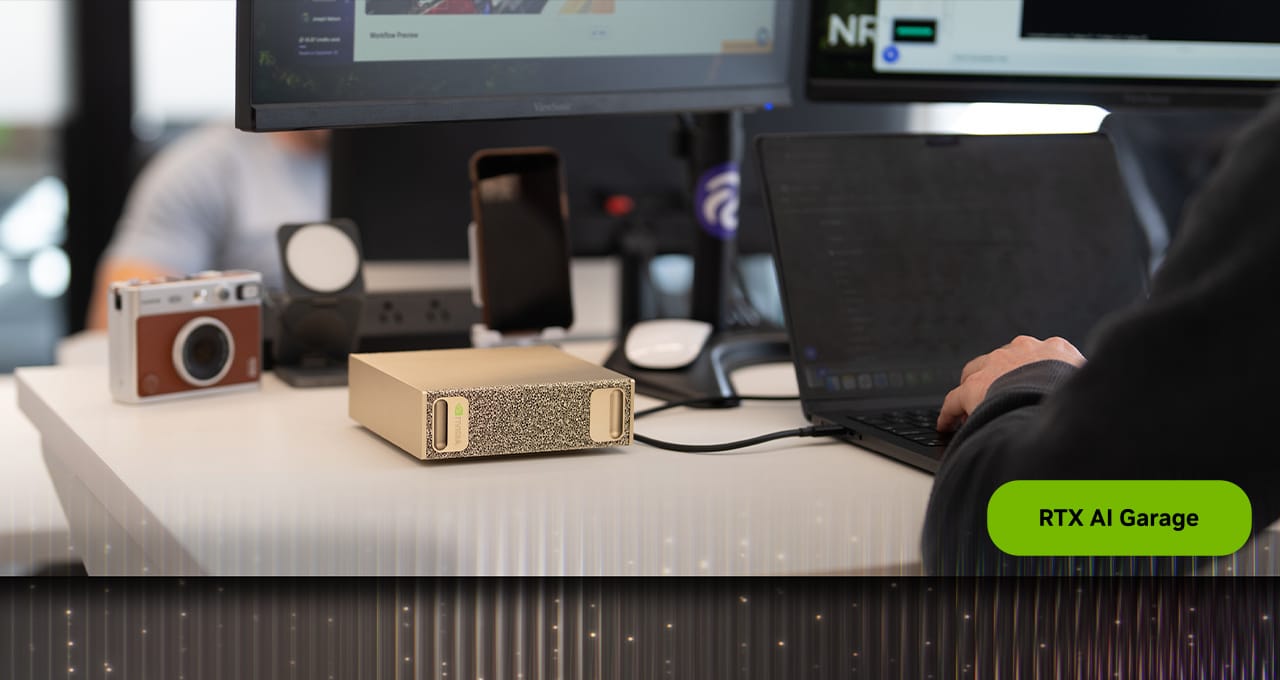
NVIDIA’s RTX Spark and DGX Spark announcements are an attempt to package that mess into a product category. The company unveiled RTX Spark as a new class of Windows PCs for personal agents, while positioning DGX Spark as the Linux developer box for always-accessible local agents. The headline specs are big — up to 1 petaflop of AI compute and 128GB of unified memory for RTX Spark, with DGX Spark built around the GB10 Grace Blackwell system — but the real story is less about one shiny box and more about turning local inference into something agents can reliably live on.
That requires four things at once: enough memory, optimized inference runtimes, usable model formats, and a security layer that does not assume “local” means “safe.” NVIDIA is trying to provide all four.
The memory number is the product
RTX Spark pairs a Blackwell RTX GPU with 6,144 CUDA cores, fifth-generation Tensor Cores with FP4 precision, NVLink-C2C, and a custom 20-core Grace CPU built with MediaTek. NVIDIA says the systems can run 120-billion-parameter LLMs with up to a 1-million-token context locally, render 90GB-plus 3D scenes, edit 12K 4:2:2 video, generate 4K AI videos, and still play AAA games at 1440p over 100 FPS. ASUS, Dell, HP, Lenovo, Microsoft Surface, and MSI are expected this fall, with Acer and GIGABYTE following.
DGX Spark is the more developer-shaped version: GB10 Grace Blackwell, 128GB LPDDR5x coherent unified memory, 273GB/s memory bandwidth, 4TB NVMe, 10GbE, ConnectX-7 at 200Gbps, Wi-Fi 7, a 240W PSU, 140W GB10 TDP, and a 1.2kg chassis. NVIDIA says it can inference models up to 200B parameters, fine-tune up to 70B, and link two systems for models up to 405B.
The unified memory is what matters for practitioners. Local agents are not single-prompt chatbots. They carry system prompts, tool schemas, repo context, file search results, scratchpads, screenshots, browser state, and multi-turn memory. The model is only one resident in the building; KV cache, serving overhead, desktop workloads, and auxiliary models all want rooms too. A GPU with excellent compute and cramped memory produces an agent that benchmarks nicely and then falls over during the real task.
This is why NVIDIA’s local-agent pitch is more credible than the usual “AI PC” sticker campaign. It is not merely saying the PC has TOPS. It is pairing memory capacity, FP4/ NVFP4 model paths, llama.cpp and vLLM work, NemoClaw installers, OpenShell runtime controls, and OEM distribution. That is the difference between selling parts and selling an operating envelope.
Benchmark the workflow, not the slogan
NVIDIA claims multi-token prediction and programmatic dependent launch deliver 2x performance on Qwen 3.6 and 3.5 27B, and 1.6x on Qwen 3.6 and 3.5 35B in llama.cpp. Tensor parallelism in llama.cpp adds up to 2x memory and 1.8x compute on two equivalent GPUs. On DGX Spark, NVIDIA says vLLM optimizations and new NVFP4 checkpoints for Qwen 3.6 35B produce 2.6x performance compared with previous NVFP4 checkpoints from Unsloth.
Those numbers are useful, but only if teams refuse to turn them into procurement poetry. A coding agent stresses a system differently from a chatbot. It does long prefill, repeats repo-context access, invokes tools, mutates files, and often sits inside a loop where latency is human-visible but total task completion is the real metric. A desktop computer-use agent stresses screen perception and action latency. A ComfyUI or video workflow stresses model chaining and memory scheduling. A private research agent stresses long context and retrieval hygiene.
The vLLM Spark walkthrough is the right kind of practical signal because it talks about the knobs: gpu-memory-utilization, max-model-len, max-num-seqs, paged KV cache, prefix caching, CUDA graphs, mixed precision, and model-specific parser flags. This is still systems engineering. The box is smaller and prettier, but the workload did not stop being real.
Engineers evaluating RTX Spark or DGX Spark should define task-level benchmarks before caring about vendor charts. How many complete repo changes per hour? How often does the agent need human correction? What is time-to-first-token for the actual prompt shape? What is sustained decode throughput under tool-heavy workloads? How much context can be kept before quality or latency collapses? What is power draw per completed task? Does the local model beat the cloud route after including operator time, not just token price?
A fresh NVIDIA Developer Forum benchmark for nvidia/Qwen3.6-35B-A3B-NVFP4 on DGX Spark reported successful synthetic request runs with output throughput around 171.64, 268.21, and 249.47 tokens per second across prompt-heavy, decode-heavy, and balanced configurations. That is encouraging, but synthetic throughput is the start of evaluation, not the end. The agent either finishes useful work or it does not.
Local does not mean harmless
NVIDIA and Microsoft are also pairing RTX Spark with OpenShell and new Windows security primitives for identity, containment, policy, and end-to-end security. Hermes Agent and OpenClaw are named as app adopters. NemoClaw is expanding across GeForce RTX, RTX PRO, RTX, DGX Spark, and DGX Station, with streamlined Linux and WSL installers and automatic sandboxing.
That security story is not an accessory. A local agent can read private files, operate applications, issue network requests, execute commands, and make changes faster than a user can inspect them. Keeping tokens off a cloud API reduces one class of risk; it does not solve permissioning, prompt injection, data exfiltration through tools, accidental destructive actions, or runaway loops. Local autonomy still needs least privilege, approvals, audit logs, and clear boundaries.
The practical architecture is hybrid. Run sensitive and high-volume work locally when the model is good enough. Route harder tasks to cloud models when policy allows. Keep OpenShell-style routing and masking explicit. Log tool calls. Make the agent ask before sending data off-machine, writing to important directories, or executing commands with side effects. Treat cost controls and privacy controls as one design problem, not two separate compliance slides.
The LGTM take: RTX Spark and DGX Spark are interesting because they turn local agents from a hobby rig into a supported platform target. The spec sheet helps, but the package matters more: memory, runtimes, optimized checkpoints, sandboxing, OEM availability, and a developer path through vLLM, llama.cpp, NemoClaw, and OpenShell. “AI PC” is mostly marketing until it can run a useful agent safely. NVIDIA is at least building the parts that make that sentence testable.
Sources: NVIDIA Blog, NVIDIA Newsroom, vLLM, NVIDIA DGX Spark, NVIDIA Developer Forum